
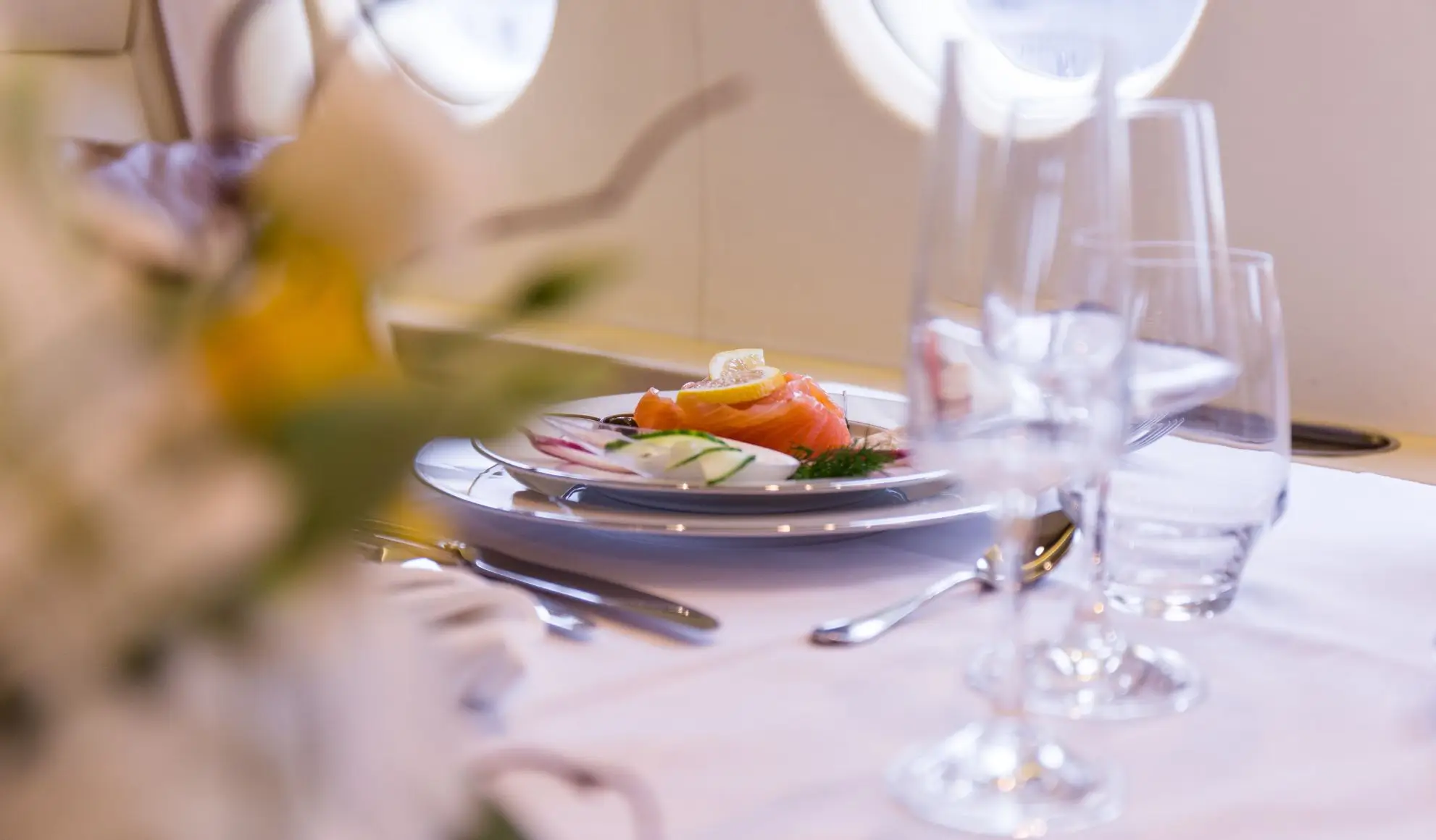
Airline catering today means far more than serving meals in the sky.
On charter flights and private jets, it has become a true expression of comfort, prestige, and brand identity, a way to create connection and well-being among passengers.
Unlike commercial airliners, where menus are rigid and standardised (especially in economy class), or low-cost airlines, where on-board catering is often limited or available only as a paid snack service, a charter flight allows every detail to be tailored. It turns the journey itself into a luxury experience. In this context, air catering evolves from a simple in-flight service into a value-added component: something that transforms the flight into part of the overall travel experience.
In 2025, passenger expectations are rapidly changing – from healthy, plant-based and gourmet menus, to sustainable and digital services that redefine what premium catering means at altitude.
Let’s explore how airline catering really works and uncover the catering trends that are reshaping the in-flight experience.
How is airline catering organised on a charter flight?

Arranging airline catering for a charter flight means coordinating several steps in perfect sync:
- Bespoke order: passenger preferences are collected as early as the flight planning stage.
- Tailored meal preparation: meals are cooked and packaged through processes designed to ensure freshness, food safety, and compliance with special dietary requests.
- Transport to the airport: the catering is delivered and managed through dedicated logistics, often under tight turnaround times.
- On-board service: the crew is trained to present each dish according to the requested standards, paying attention to both service quality and aesthetics.
Unlike a commercial airliner, there is no fixed in-flight menu to choose from. Each meal is pre-arranged and can be tailored to the requests of the group or individual passengers.
When a charter flight is requested, the operator usually proposes a standard on-board menu; it is up to the client to decide whether to accept it or customise it (sometimes with an extra cost), depending on the purpose of the trip, whether it’s a MICE event, a sports transfer, or a business flight on a private jet.
This is where the broker comes in: a key figure who translates customer expectations into precise requests for the airline, ensuring that a standard offer becomes a bespoke catering service aligned with the passenger experience.
Why is airline catering a key aspect of private flights?

Every flight has its own requirements, depending on the purpose of the journey.
For instance, a charter flight for a sports team may require a special menu designed in collaboration with the team’s nutritionist; during an incentive travel, the on-board catering becomes a distinctive element that enhances the event.
Airline catering is not just an accessory: it’s an integral part of the perceived value of a flight.
It ensures:
- Comfort and well-being: light, healthy, or energising meals adapted to each stage of the journey.
- Food safety: careful management of allergies and intolerances.
- Specific requirements: religious, medical, or athletic menus designed for sports teams.
- Branding and experience: during MICE or corporate flights, the menu becomes an extension of the company’s brand identity.
If you’d like to explore more about tailoring services for MICE flights, read our dedicated news on charter flights for the MICE sector.
7 gourmet trends redefining the airline catering experience

What are the passenger requests shaping airline catering trends in 2025?
Here are seven key directions that are transforming the way on-board catering is experienced on charter flights and private jets, from luxury catering concepts to the evolution of premium in-flight dining.
1. Personalised and tailor-made menus
In air chartering, passengers are no longer limited to the classic “chicken or pasta” choice.
Today, they can enjoy dishes created ad hoc: from an energising breakfast before a sports competition (ideal for charter flights dedicated to athletic teams), to comforting meals that make long journeys feel more like home, or even a special menu inspired by local cuisine to set the mood for the destination ahead.
In every case, the on-board catering reflects the identity and purpose of the trip, combining taste, comfort, and tailoring to meet each passenger’s unique expectations.
2. Plant-based cuisine and well-being in flight
The trend towards healthy airline catering is growing fast. An increasing number of airlines and charter flight operators are introducing vegan, vegetarian, low-calorie, gluten-free, or superfood-enriched dishes (such as chia, spirulina, or goji berries) into their on-board catering offers. These options help reduce the feeling of heaviness caused by rich meals at altitude, while promoting better digestive and metabolic well-being during the journey.
Sector studies indicate that the demand for gourmet and healthy menus on charter flights has been steadily increasing, with double-digit growth in recent years, reflecting a growing awareness among passengers of the importance of health, energy, and comfort, even on board.
Many operators are now collaborating alongside nutritionists and specialised chefs to design balanced and easily digestible menus, combining plant-based proteins, fibres, healthy fats, and organic or locally sourced ingredients.
In this way, healthy air catering is also becoming part of a wider commitment to sustainability, through compostable packaging, reduced food waste, and a greener approach to luxury travel.
3. Global culinary experiences
Airline catering is embracing a truly international spirit.
Ethnic cuisines, fusion influences, and traditional recipes are taking centre stage: from refined sushi boxes to vibrant Mediterranean dishes, every charter flight can become not just a journey through the skies, but a cultural voyage that celebrates flavour, diversity, and discovery.
4. Mini-portions and tasting menus
The mini-meal concept – small dishes served in sequence – allows passengers to enjoy a variety of flavours in a shorter time. Ideal for short-haul charter flights or to help maintain focus and energy during business flights, this approach to luxury airline catering offers variety and sophistication without weighing passengers down. This approach to premium catering allows for offering variety and refinement without burdening the passenger.
5. Signature cocktails and gourmet pairings
Luxury airline catering now includes the art of mixology.
Handcrafted cocktails, expertly paired with selected wines or premium champagne, bring a new level of sophistication to on-board catering.
From aperitifs to after-dinner drinks, these prestige catering experiences transform the in-flight service into a luxury dining moment, one that passengers remember long after landing.
6. Sustainable packaging and waste reduction
Sustainable airline catering is no longer an exception: it’s becoming one of the industry’s key frontiers.
Major in-flight catering providers are now investing in compostable packaging, recyclable materials, waste reduction, and local supply chains, precisely to respond to regulatory and environmental pressures.
According to recent market data, the zero-waste in-flight catering segment reached an estimated value of USD 2.17 billion in 2024, with an expected annual growth rate of 7.8% through 2033.
At the same time, international organisations such as IATA are emphasising the need to reduce and recycle cabin waste, encouraging the adoption of standard sustainable practices across the sector.
On an operational level, many companies are implementing predictive algorithms and just-in-time models to balance food production, minimising unnecessary waste.
However, one major challenge remains: on international flights, cabin waste is often subject to strict sanitary regulations that require incineration or sterilisation, making effective recycling more complex.
In this scenario, sustainable packaging – whether biodegradable, compostable, or reusable -and waste reduction are not merely ethical choices: they are becoming strategic differentiators, especially for charter flights and private jets that aim to deliver both premium and responsible travel experiences.
7. Technology and digitalisation in on-board catering
With the rise of new technologies and digitalisation, on-board catering is undergoing a significant transformation.
It’s no longer just about choosing a special menu before the flight; it’s about introducing smart systems that make the service smoother, faster, and tailored.
The main innovations include:
- Integrated digital pre-orders: passengers can select their special menu or dietary preferences when confirming their charter flight, reducing errors and management time.
- Real-time preference tracking: dedicated platforms allow crews and travel managers to access an overview of passenger requirements – from allergies and special diets to athletic needs – ensuring greater safety and punctuality.
- Predictive algorithms to minimise waste: airlines can accurately forecast the quantity and type of meals to prepare, contributing to sustainable catering practices.
- Digital coordination platforms: systems that connect clients, brokers, and airlines, centralising orders and last-minute adjustments for a seamless workflow.
For passengers, this means greater transparency, comfort, and assurance.
For travel managers, digitalisation becomes an operational advantage: better cost control, fewer disruptions, and the ability to manage large groups – such as MICE or sports teams – with ease.
For now, it remains a work in progress: digital tools are not yet the standard, but the industry is rapidly moving in this direction, driven by the growing demand for premium, tailor-made airline catering.
Airline catering: the real differences between charter and commercial flights
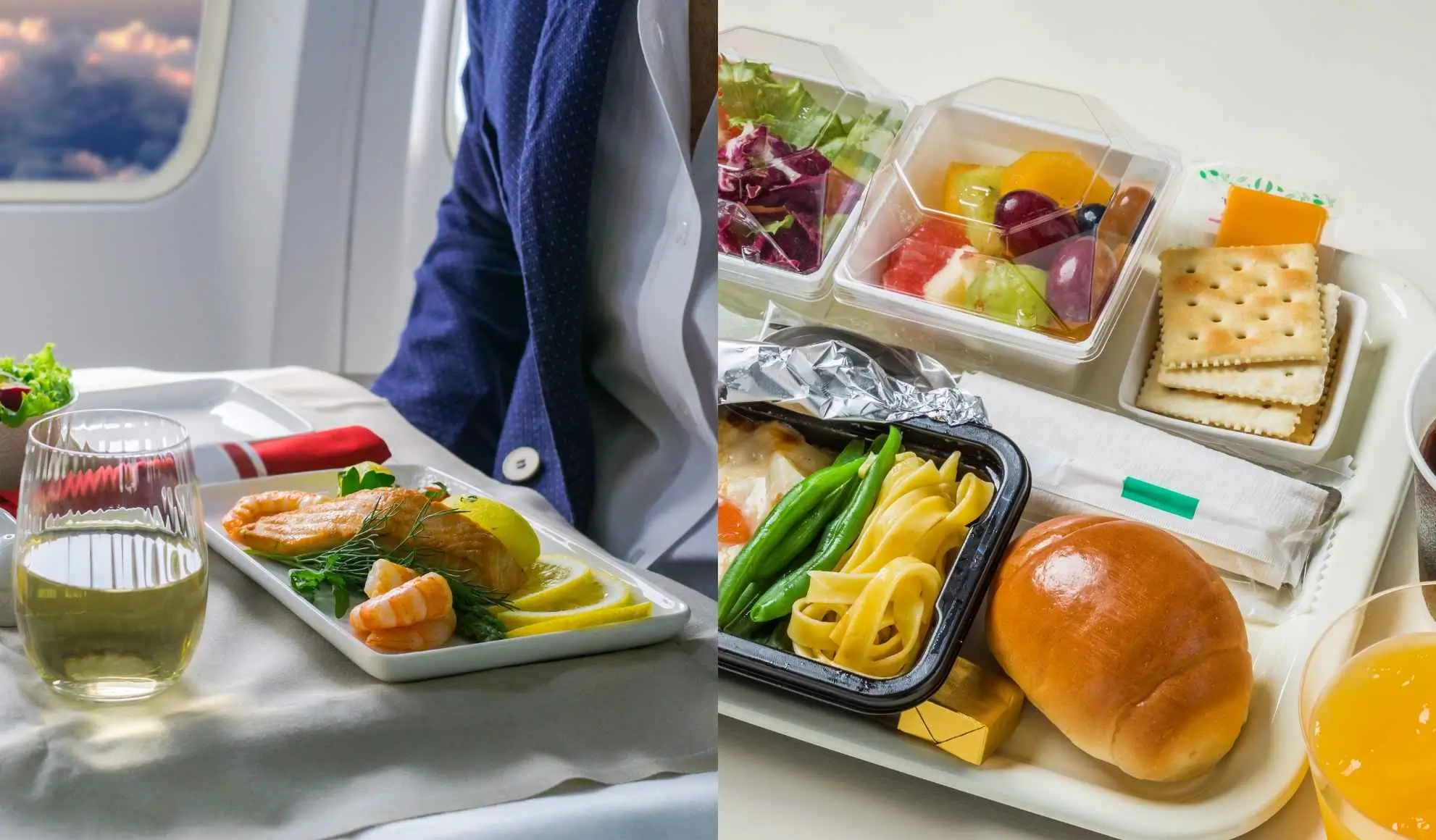
The airline catering offer varies greatly depending on the type of flight.
On commercial airliners, the service is standard, while on a charter flight, tailoring becomes the rule.
Here’s a comparative overview:
Type of flight
| Type of flight | Catering offer | Level of tailoring | Distinctive features |
| Economy class (commercial flights) | Fixed, limited menu | Low | Rigid planning, few options available |
| remium class (business/first) | High-quality gourmet meals | Medium | Wider choice, but still within pre-set menus |
| Executive jet for business travel | Premium catering and luxury in-flight dining focused on efficiency, comfort, and gourmet quality | High | Light, healthy or “energy-boosting” meals designed to optimise time and productivity during travel |
| Private charter flights (groups, MICE, sports teams) | Fully flexible, tailor-made menus | Very high | The client defines every detail: dishes, timing, branding, and special services (religious, medical, athletic) |
t’s also worth noting that on low-cost airlines, catering is often not included at all: meals or snacks are usually available only as a paid add-on, and with a limited selection.
Checklist: what to consider when choosing your airline catering service

To make airline catering a real strength of the travel experience, here’s what to consider during the planning stage:
- Clearly communicate any allergies or dietary restrictions.
- Define whether the flight requires light, energy-boosting, or representative meals.
- Evaluate sustainable options (packaging and sourcing).
- Consider the flight duration: short routes → snacks or mini-portions; long-haul flights → full meals.
- Set a budget and prioritise the most important tailoring options.
Airline catering on charter flights: how Flyness supports you

In an industry where many providers only pass on the airline’s standard order, Flyness takes it one step further: we analyse every client’s needs, anticipate potential issues, and turn requests into bespoke, practical solutions.
We go beyond menu selection, interpreting the context of each journey, whether it’s a MICE event, a sports transfer, or an executive flight, and ensure that on-board catering becomes an integral part of the travel experience.
This means managing not only preferences but the entire airline catering workflow, coordinating premium catering solutions that reflect the spirit and purpose of the travel.
- Collecting passenger preferences and managing every special request.
- Operational coordination with airlines to ensure feasibility and quality.
- Providing an all-inclusive, transparent quote with no hidden costs.
Flying with Flyness means enjoying a service that speaks your language from take-off to the final course served on board.
Frequently asked questions about airline catering on private flights
Can you request special menus on a private jet?
On a private jet, passengers can request special menus: from vegan or vegetarian meals to religious, medical, or athletic diets, all carefully prepared to meet individual preferences and requirements.
How much does on-board catering cost on a charter flight?
The cost of airline catering on a charter flight depends on the level of tailoring, the type of menu requested, and the number of services provided during the journey (one or more meals may be served depending on flight duration).
It is always included as a specific item in the charter quote, ensuring full transparency from the planning stage.
Who prepares the meals for a private flight?
Meals served on private jets and charter flights are prepared by chefs and suppliers specialised in airline catering, who must comply with strict quality and safety standards.
In Italy, this activity is regulated by ENAC (Italian Civil Aviation Authority) in accordance with European guidelines set by EASA and must follow HACCP food hygiene protocols.
These certifications ensure that food served on board is safe, traceable, and suitable for consumption in the specific conditions of aviation.
What does catering on a charter flight include?
On-board catering on a charter flight can include full meals, snacks, beverages, cocktails, fine wines, and even customised packaging, depending on the client’s preferences.
Every journey has its destination, but also its atmosphere.
Airline catering helps create it: a light dish for a business flight, a gourmet toast to celebrate an incentive, or a special menu that tells the story of a culture.
Even thousands of feet above the ground, taste becomes part of the journey.
Contact us and request your bespoke quotation.