
Coordinating business travel across multiple cities within a few days has become an increasingly common requirement for companies, managers and international teams.
According to the European Business Travel Barometer (Q2 2025), more than 70% of executive business trips include at least one intermediate stop within the same journey. However, 84% of Travel Managers report that missed connections, delays and the rigidity of scheduled airline services generate high hidden costs, in terms of lost working hours and additional overnight stays.
In this context, multi-leg business jet flights offer a practical solution to optimise time, schedules, and overall business travel organisation.
Business flights and business travel: why multi-leg is a strategic choice

Modern business flights no longer follow a linear “outbound and return” logic. Closely scheduled meetings, offices spread across multiple European capitals, and increasingly tight decision-making windows require travel designed as a single operational flow.
The limitation of traditional business travel is not just flight time, but everything that surrounds it:
- Waiting time at airports.
- Agenda reconfigurations.
- Unplanned overnight stays.
- Loss of continuity between one leg and the next.
Instead, a business jet allows the sequence of movements to be structured and aligned with the real objectives of the trip.
Connecting flights or business jet: impact on time and business travel organisation
Scheduled connecting flights are often chosen to optimise direct costs, but they rarely take into account their impact on business travel organisation.
| Connecting scheduled glight | Business jet |
|---|---|
| Connections and waiting times | Direct routing |
| Congested hubs | Business aviation airports |
| Fixed schedules | Flexible schedules |
| Risk of cascading delays | Agenda under control |
| High indirect costs | Operational continuity |
The main difference is not just the flight mode, but the management of time and priorities. When one leg is delayed or cancelled, the entire trip loses effectiveness.
Example of multi-city business travel across Europe
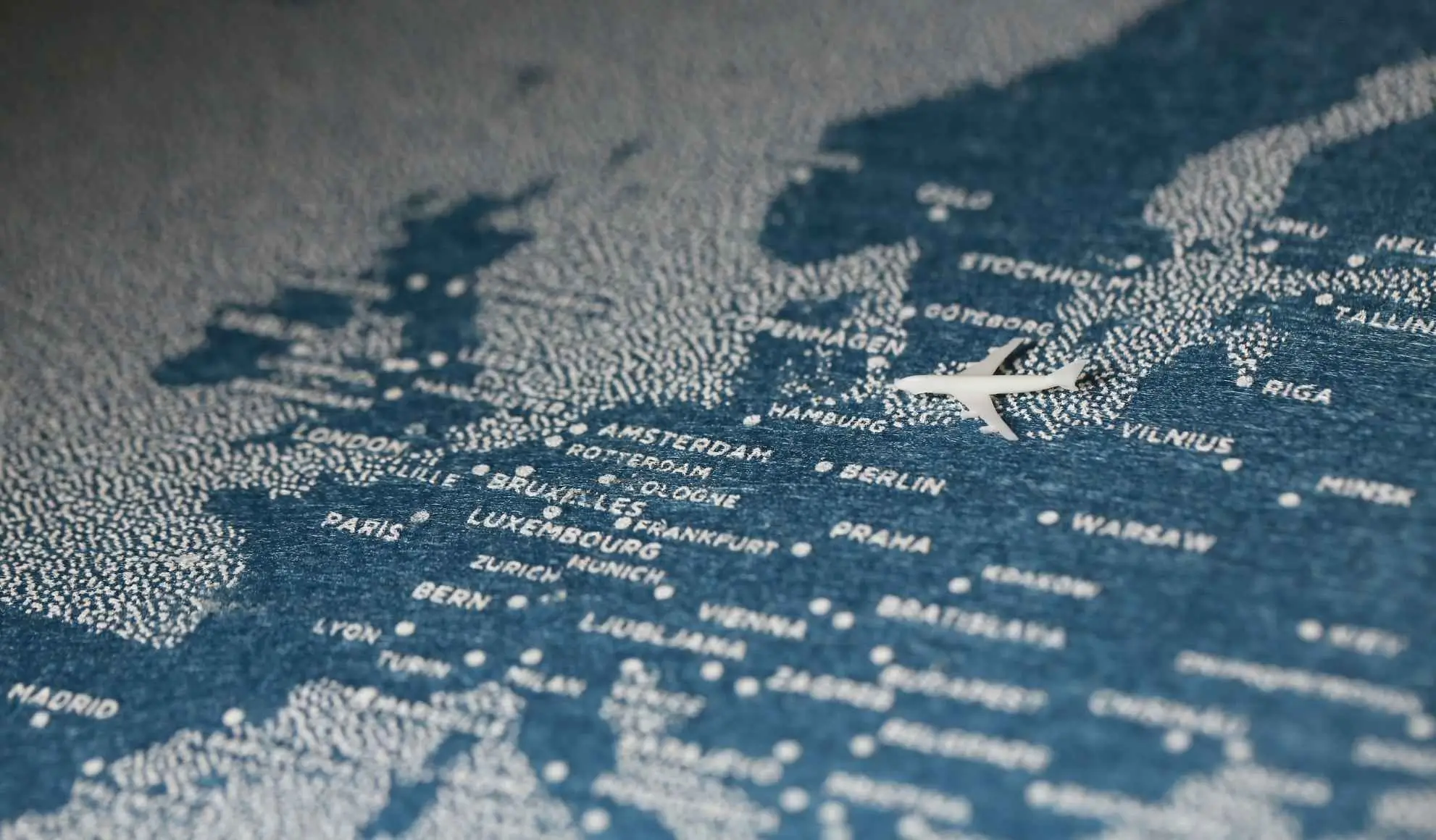
A well-designed multi-leg itinerary allows for concentrating multiple decision-making meetings within a short time frame, without fragmenting the agenda.
Operational example:
Day 1 – Milan → Paris
- 07:30 – Departure from Milan Linate (business aviation terminal).
- 08:45 – Arrival at Paris Le Bourget.
- 09:30–17:00 – Meetings with local teams and clients.
Day 2 – Paris → Berlin
- 08:00 – In-flight briefing during the flight.
- 09:45 – Arrival at a city-centre airport in Berlin.
- 10:30–16:00 – Operational visits and site inspections.
- Return to Italy in the evening.
In this scenario, the choice of airports and the continuity of the aircraft significantly reduce ground transfers, idle time and additional overnight stays, making the trip truly aligned with business objectives.
Time management during business travel: the role of the business jet
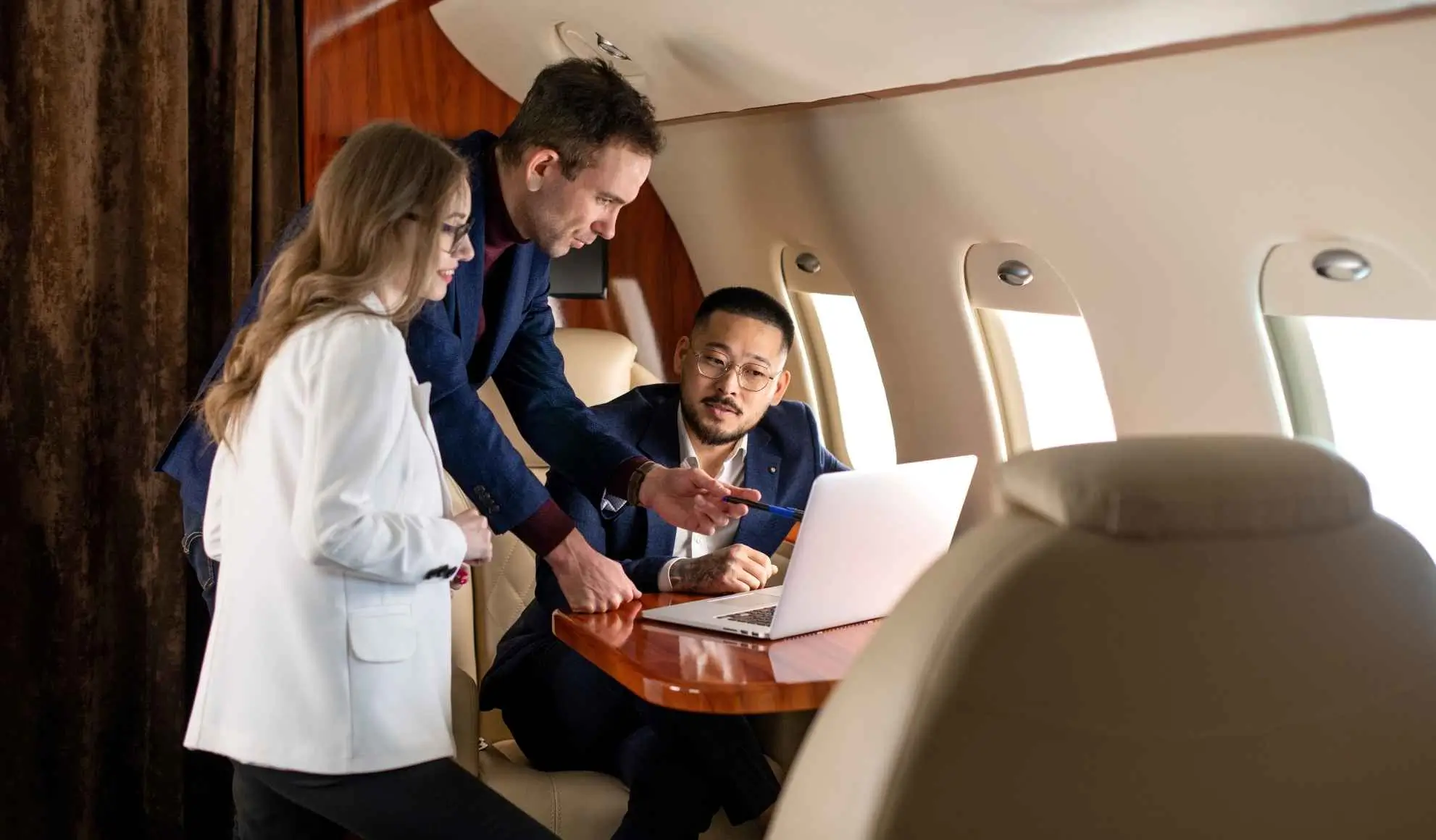
Time management during business travel is one of the most underestimated aspects, yet also one of the most expensive. Every hour lost between airports translates into postponed decisions, less aligned teams and increased organisational pressure.
A business jet makes it possible to:
- Maintain work continuity even while in flight.
- Use transfer time for briefings and alignment.
- Avoid unused operational windows.
- Return the same day when required.
On a business jet flight, time management doesn’t stop at take-off. Today, thanks to onboard Wi-Fi connectivity systems even at cruising altitude, flight time can be transformed into effective working time (operational calls, document sharing and coordination with ground teams).
This continuity allows the decision-making flow to remain active while travelling, preventing the flight from becoming a “dead zone” in the agenda. To explore how onboard Wi-Fi works and what the real operational possibilities are, you can read the dedicated article on the Flyness blog.
Private jet costs and business flights optimisation

When discussing private jet costs, the most common mistake is to focus solely on the hourly rate. In reality, for multi-leg business jet flights, the final cost depends on a range of operational variables:
- The number and sequence of legs.
- Airport selection (handling, parking, slots).
- Crew management and stopovers.
- Return flight planning.
- Reduction of indirect costs (hotels, ground transfers, extra days).
A well-structured itinerary often makes it possible to offset the direct cost of the flight with overall savings across the entire trip, especially when the value of the time of the people involved is high.
If you would like a clearer indication of private jet charter costs, including estimated hourly rates, you can find an overview in our article “Bleisure travel and executive jet charter: how to combine work and leisure” on the Flyness blog.
The role of the charter flight broker in business travel organisation

In the organisation of complex business travel, the role of a charter flight broker goes far beyond sourcing an available aircraft. For Flyness, the broker acts first and foremost as an operational director, responsible for ensuring consistency between travel objectives, the decision-making context and the flight solution.
Every project starts with an in-depth analysis of the requirement: non-negotiable timelines, the level of flexibility needed, potential critical issues, the value of confidentiality and the operational impact of the itinerary.
The route and the aircraft are not the starting point, but the outcome of a broader assessment that considers the entire travel cycle.
The Flyness method is built on three pillars:
- Analysis.
- Design.
- Accountability.
This approach permits the delivery of tailor-made solutions that go beyond standard proposals and anticipate the variables that can affect time, costs and operational continuity.
Planning does not end with the quotation phase, despite persisting through the active management of the flight, coordination of ground activities and full oversight of the operation until the mission is completed.
Flyness operates as a single point of contact, integrating:
- Carrier selection.
- Verification of safety and reliability standards.
- Coordination with airports and handling agents.
- Continuous supervision of the overall experience.
In this way, even complex multi-leg itineraries are managed as one seamless experience, frictionless and always under control.
In a dynamic and fragmented market like executive aviation, value does not lie solely in the selected aircraft, but in the ability to govern complexity. This is where the Flyness method makes a difference: a strategic partner for companies and decision-makers seeking clarity, continuity and reliability in their business travel.
Frequently asked questions about business jet travel

How many legs can be managed in a business jet work trip?
It depends on distance, objectives and operational windows. In Europe, itineraries involving two or three cities within 48 hours are feasible when properly designed.
Is a multi-leg business jet flight always more expensive than connecting flights?
Not necessarily. When indirect costs, additional overnight stays and lost working hours are considered, the overall balance can prove more efficient.
Is it possible to work during the flight?
Yes, it is. Many executive aircraft are equipped with Wi-Fi systems that allow operational continuity even at cruising altitude.
What is the advantage of relying on a charter flight broker?
An experienced broker manages the complexity of the operation, coordinates all parties involved and ensures alignment between objectives, timelines and the flight solution.
Business travel today: when the business jet simplifies complexity

Contemporary business travel directives solutions that go beyond simple transportation. In complex trips involving multiple cities and little margin for error, the business jet is not a comfort-driven choice, but a strategic tool for managing time and decision-making.
In certain contexts, the flexibility of a business jet can also be used to integrate professional and personal needs within the same trip. When this balance becomes part of the travel strategy, it enters the realm of bleisure travel, a topic Flyness addresses in a specific and distinct in-depth article.
When there is a method, complexity turns into fluidity.
With Flyness, every flight becomes an integral part of the work organisation.
Would you like to assess whether a multi-leg business jet flight is the right solution for your next business trip?
Contact us for a dedicated consultation.